The ATSB has searched underwater around 120,000 km2 of the Southern Indian Ocean from 40°S to around 33°S.
Ocean Infinity has searched underwater around 140,000 km2 of the Southern Indian Ocean from 36°S to 25°S.
Oliver Plunkett, the CEO of Ocean Infinity, said recently that “If nothing else, we can say with confidence that it isn’t where we looked. That matters – it brings clarity, and it will help those continuing to study the evidence refine their thinking and shape future search strategies.”
So how should we refine our thinking and shape future search strategies ?
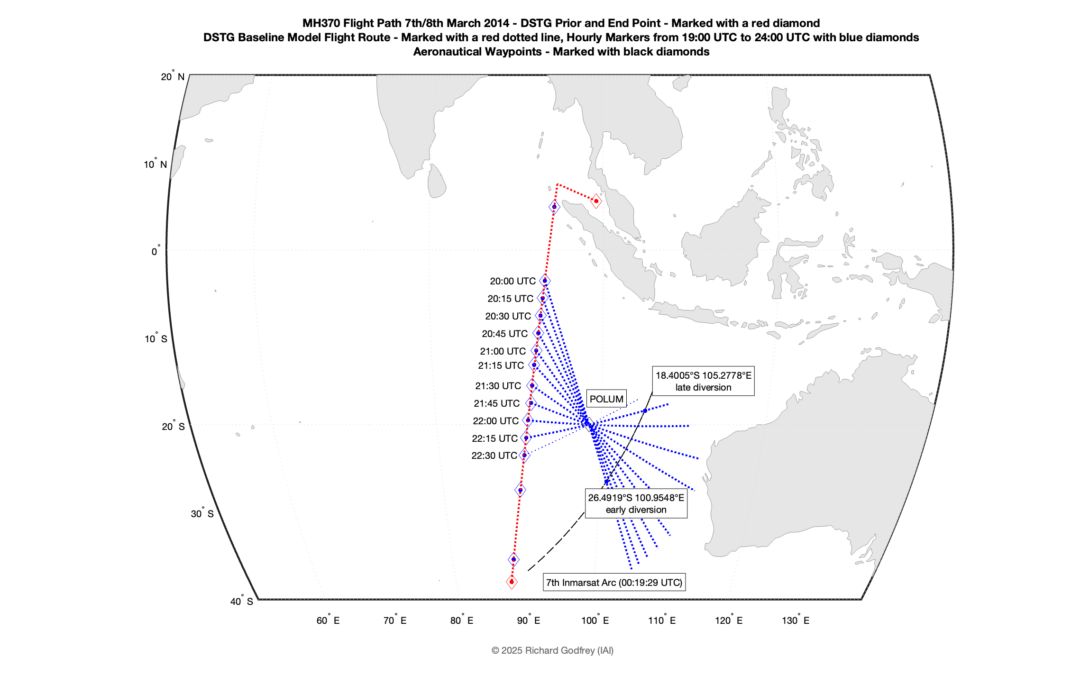
The Bayesian search framework developed by the Australian Defence Science and Technology Group (DSTG) provided the first rigorous probabilistic analysis of the final trajectory of Malaysia Airlines Flight MH370. That analysis combined a radar-derived prior, Inmarsat BTO and BFO measurements, and a stochastic aircraft dynamics model to estimate the distribution of possible crash locations along the southern part of the 7th Inmarsat arc.
The present study revisits one modelling choice within that framework: the restriction imposed on the post-radar aircraft dynamics in the state-transition model. The original DSTG analysis effectively constrained the aircraft to follow a limited set of heading-based trajectories following the final radar observation. In this study, the prior and measurement models are retained unchanged, while the aircraft dynamics model is modified to permit a single LNAV direct-to waypoint command during the southbound phase of flight.
Illustrative trajectory propagations demonstrate that allowing a single waypoint event can significantly expand the range of trajectories that remain consistent with the timing constraints imposed by the sequence of Inmarsat arcs. In particular, the latitude interval along the 7th arc reachable under this modified model depends strongly on the geometry of the commanded waypoint and the timing of the diversion. Waypoints located further from the baseline southbound trajectory produce larger timing variations and correspondingly wider ranges of possible arc intersections, while waypoints located closer to the baseline trajectory produce smaller variations.
These results highlight that the inferred crash region derived from the DSTG framework is sensitive to assumptions embedded in the aircraft dynamics model. The analysis presented here does not attempt to determine the most likely flight path or crash location. Rather, it demonstrates that relaxing a single modelling constraint within the DSTG framework expands the set of trajectories consistent with the available measurements. This finding underscores the importance of carefully examining modelling assumptions when interpreting probabilistic search results for MH370.
In Bayesian trajectory inference, the posterior distribution reflects the interaction of the measurement likelihood with the assumed prior and state-transition dynamics; consequently, changes to the trajectory model can alter the structure of the posterior search region even when the observational data remain unchanged.
You can download the paper “Trajectory-Dynamics Sensitivity of the DSTG Bayesian Search Model for MH370” here
Recent Comments